


In an effort to encourage condominium development and expand homeownership opportunities, Washington recently enacted HB 2304. The legislation seeks to reduce liability-related barriers that increase the cost and risk of condominium development. Specifically, HB 2304 expands the types of condominium projects eligible to use the 2-10 warranty framework instead of the implied warranties otherwise required under Washington law.
Why the Reform?
HB 2304 builds on Washington's earlier efforts to reform condominium liability laws. In 2025, the Legislature enacted HB 1403, which first allowed certain condominium developers to use the 2-10 warranty framework as an alternative to the implied warranties otherwise required under the Washington Uniform Common Interest Ownership Act (WUCIOA). However, that option was available only for a limited category of smaller condominium projects—generally those containing 12 or fewer units and meeting certain height restrictions. HB 2304 expands eligibility by making the alternative warranty option available to additional four-story condominium projects that meet the statutory requirements.
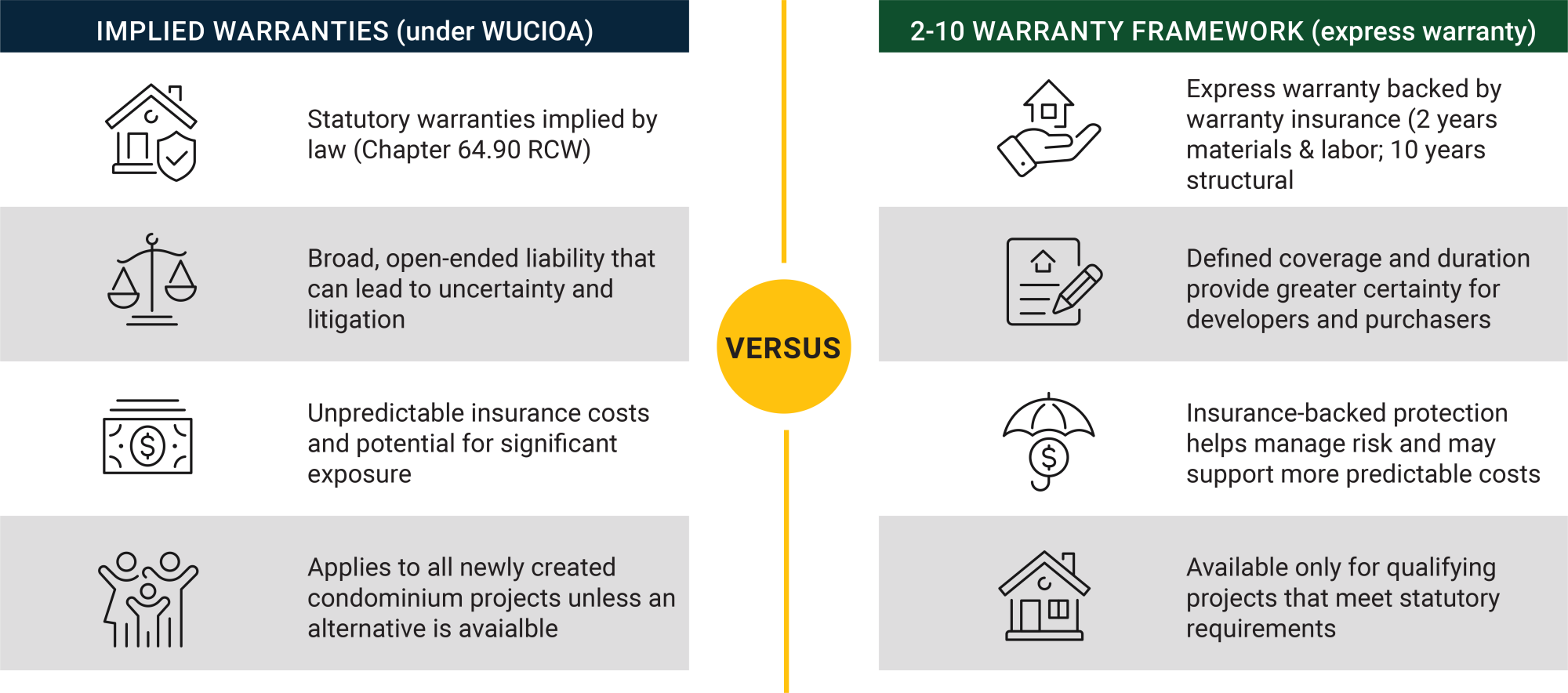
WUCIOA, codified in Chapter 64.90 RCW, establishes the statutory framework governing Washington common interest communities, including the implied warranties applicable to newly created condominium projects. These recent reforms respond to longstanding concerns that uncertainty surrounding those implied warranties, litigation exposure, and insurance costs has discouraged condominium development. As a result, many developers have favored apartment projects over condominiums, despite continued demand for entry-level homeownership opportunities.
Building on HB 1403
By expanding the availability of the 2-10 warranty framework to include additional qualifying four-story condominium projects, the Legislature hopes to encourage additional condominium development while maintaining meaningful consumer protections.
Unlike the implied warranties established under WUCIOA, the 2-10 warranty is an express warranty backed by warranty insurance, providing defined coverage for qualifying projects. Although purchasers continue to have legal remedies when appropriate, the alternative warranty framework may provide developers with greater certainty regarding warranty obligations and insurance coverage.
Expanding eligibility to four-story buildings may create new opportunities for smaller condominium developments. Allowing these projects to utilize the 2-10 warranty framework may make them more attractive to developers considering for-sale condominium projects.
What Does This Mean for Developers?
Developers considering smaller condominium projects should evaluate whether the expanded warranty framework creates opportunities that may not have existed under prior law. While HB 2304 does not eliminate construction-defect liability or implied warranty protections in every circumstance, it expands the availability of an alternative warranty option that may provide a more predictable framework for managing risk.
Developers evaluating proposed condominium projects should discuss the expanded warranty option with legal counsel, lenders, and insurance brokers early in the planning process to determine whether qualifying projects may benefit from the revised framework.
Whether the legislation ultimately lowers insurance costs or encourages additional condominium construction remains to be seen. Those outcomes will likely depend on how insurers, lenders, developers, and the broader market respond to the expanded warranty framework.
Conclusion
HB 2304 is the latest in a series of legislative efforts to encourage condominium development in Washington, although whether it ultimately succeeds will depend on how developers, insurers, lenders, and the broader market respond. For developers considering smaller condominium projects, the expanded warranty framework may make some developments more attractive than they were under prior law. Developers planning smaller condominium projects should consult with legal counsel, lenders, and insurance brokers early in the planning process to determine whether the expanded warranty option may benefit their project.
This article is intended for general informational purposes only and does not constitute legal advice.
 Summer Intern
Mekdes chose to attend law school after gaining experience in family law as a legal assistant and working in legal operations at a venture capital firm. She is interested in business, international law and sustainable development ...
 Partner
As former in-house counsel to a real estate development company, Angela brings a practical and business-focused mindset to her work. She is recognized by clients for her efficiency, effectiveness, and creative solutions as well as ...
About this Blog
Stay current on legal news and issues, and learn more about Summit Law Group's practice groups.
Topics
Archives
Authors
Recent Posts
- Washington Expands Condo Liability Reform: What Developers Need to Know
- Preparing Seattle for the World Stage: Reflections on the Road to the 2026 FIFA World Cup
- What Lawyers and AI Companies Need to Know About Washington's HB 1170
- Quantum Computing and Data Security: What Lawyers and Businesses Should Know
- Washington's AI Task Force Interim Report Explained: What Public Agencies, AI Vendors, and AI Deployers Need to Know
- AI Transparency: A Tale of One Task Force and Two States’ Legislative Bills
- AI Bias and How to Mitigate It
- Washington Employment Law Update: August 2025
- HB 1096 and SB 5559: Increasing Washington's Housing Supply Through Lot Splits and Unit Lot Subdivisions
- SB 5129: What it Means for HOAs, Homeowners, and the Future of Common Interest Communities