
As Washington continues to address its housing shortage, the Legislature has increasingly focused on encouraging development in areas already served by public transit. HB 1491, signed into law in 2025, builds on that effort by requiring many cities planning under the Growth Management Act to allow greater residential density near qualifying bus stops and rail stations.
For developers, the legislation presents new opportunities to increase residential density, reduce parking requirements, and take advantage of financial incentives for qualifying projects.
Why the Reform?
HB 1491 reflects the Legislature’s goal of promoting housing where transportation infrastructure already exists. By encouraging higher-density residential development near transit, lawmakers hope to increase housing supply, reduce reliance on automobiles, and support more efficient land use.
The legislation also seeks to encourage the development of affordable and workforce housing by pairing increased development capacity with affordability requirements and financial incentives.
What Does HB 1491 Require?
HB 1491 applies to qualifying development within designated station areas, generally defined as:
- within one-quarter mile walking distance of qualifying bus stops; or
- within one-half mile walking distance of rail station entrances (or one-quarter mile in certain smaller cities).
Qualifying developments must also satisfy minimum floor area ratio (FAR) requirements, which establish the minimum development intensity permitted within station areas. Required FARs vary depending on whether a project is located near bus or rail transit and whether a city has exercised certain statutory exemptions.
In addition, qualifying projects must satisfy long-term affordability requirements. Generally, projects must maintain either:
- at least 10% affordable housing units for a minimum of 50 years; or
- at least 20% workforce housing units for at least 50 years, with reduced requirements for certain family-sized developments.

What Incentives Does the Law Provide?
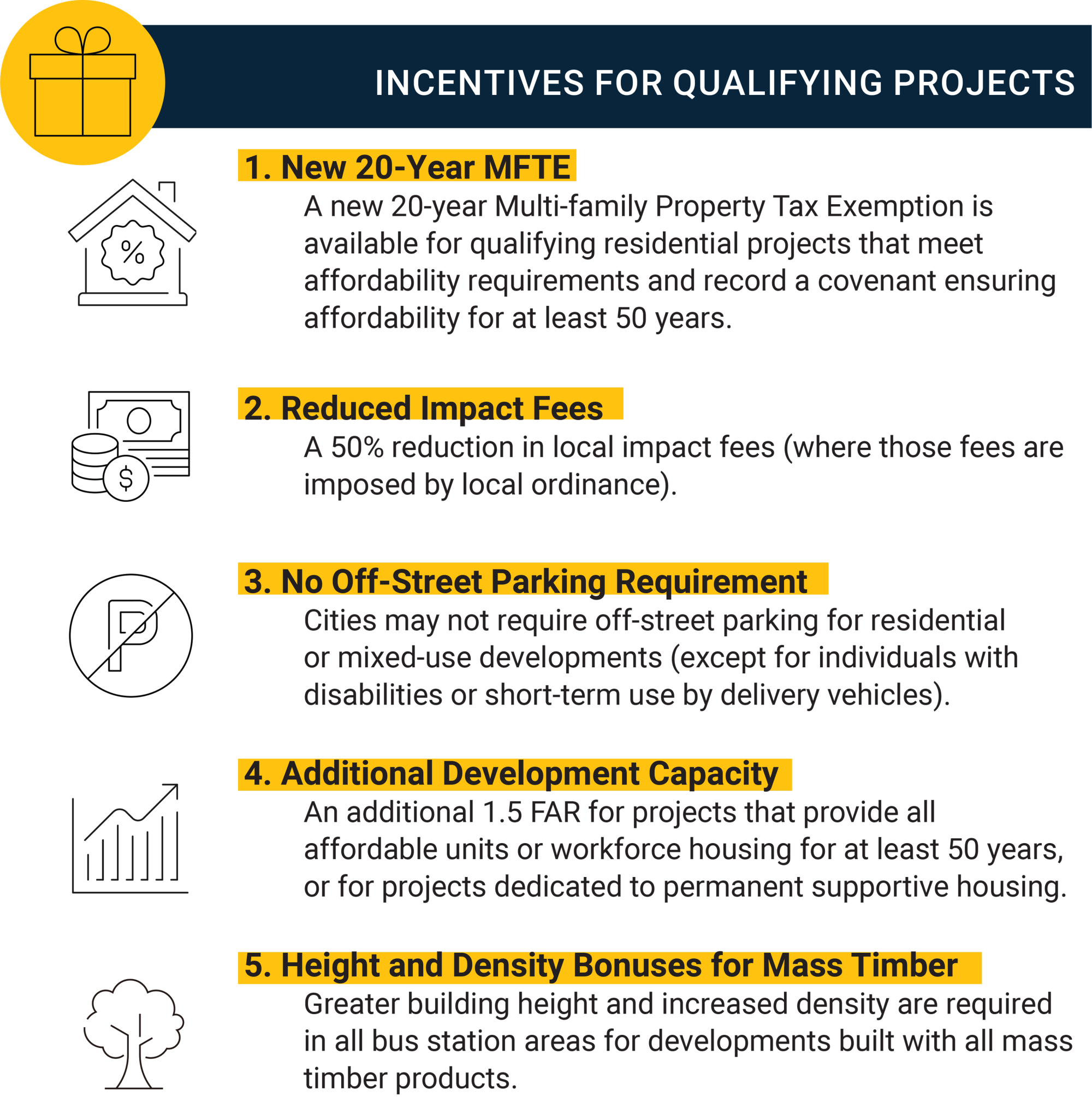
HB 1491 pairs these development requirements with several incentives designed to encourage transit-oriented housing, including:
- a new 20-year Multifamily Property Tax Exemption (MFTE) for qualifying residential projects;
- a 50% reduction in local impact fees, where applicable;
- significant limitations on local off-street parking requirements for residential and mixed-use developments;
- additional allowable development intensity for projects providing long-term affordable or workforce housing; and
- increased building height and density allowances for certain mass timber developments located within bus station areas.
Together, these incentives may improve the financial feasibility of qualifying residential developments while supporting the Legislature's broader housing objectives.
What Does This Mean for Developers?
For developers, HB 1491 creates opportunities to build denser residential projects in areas with existing transit infrastructure while reducing some of the regulatory and financial barriers that can affect project feasibility.
Developers considering projects near qualifying transit stations should evaluate whether their properties fall within designated station areas and whether the available incentives—including reduced parking requirements, lower impact fees, and the new MFTE—may improve project economics.
Because implementation will occur through local comprehensive plan updates, developers should also monitor how individual jurisdictions amend their development regulations to comply with the new law.
When Does the Law Take Effect?
HB 1491 will be implemented according to each city's comprehensive plan update schedule under the Growth Management Act. As local governments revise their development regulations, developers should watch for changes affecting zoning, density, parking requirements, and available incentives within station areas.

Bottom Line
HB 1491 represents another significant step in Washington's effort to encourage transit-oriented residential development. By combining increased development capacity with financial incentives and streamlined development standards, the legislation creates new opportunities for qualifying residential projects located near transit.
Developers evaluating projects within designated station areas should review the new law carefully and consult with legal counsel early in the planning process to determine how local implementation may affect future development opportunities.
This article is intended for general informational purposes only and does not constitute legal advice.
 Partner
As former in-house counsel to a real estate development company, Angela brings a practical and business-focused mindset to her work. She is recognized by clients for her efficiency, effectiveness, and creative solutions as well as ...
About this Blog
Stay current on legal news and issues, and learn more about Summit Law Group's practice groups.
Topics
Archives
Authors
Recent Posts
- Rent Stabilization is Live in Washington: Are Your Rent Increase Notices Compliant?
- Oregon Doubles Down on Middle Housing: What HB 2138 Means for Developers
- Washington's Amended Fair Chance Act Is Live: Are Your Organization's Processes Compliant?
- Moving Your LLC Out of Washington: What Property Owners Should Know
- Negotiating Leases as a Commercial Tenant
- Construction Defect Reform Comes to Oregon: What Developers and HOAs Need to Know
- Washington Limits Parking Requirements: What SB 5184 Means for Developers
- New Development Opportunities Near Transit: What Washington's HB 1491 Means for Developers
- Washington Expands Condo Liability Reform: What Developers Need to Know
- Preparing Seattle for the World Stage: Reflections on the Road to the 2026 FIFA World Cup