

Washington’s rent stabilization law has now been in effect for more than a year. Here’s what landlords should know about rent caps, exemptions, notice requirements, lease parity, and enforcement under HB 1217.
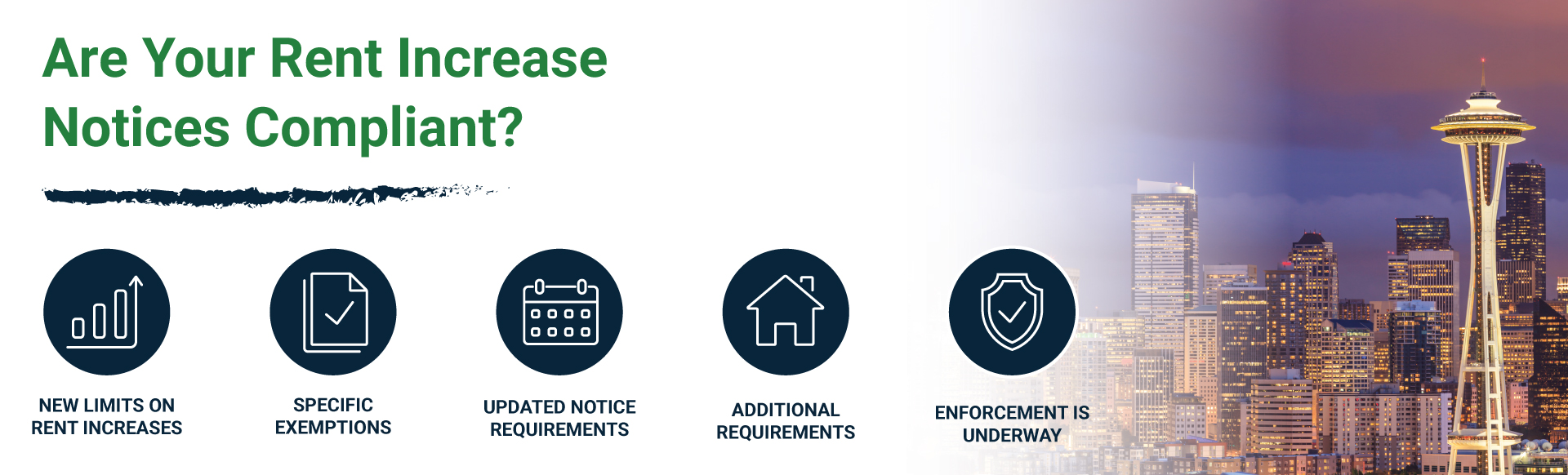
Washington’s rent stabilization law has been in effect since May 7, 2025. Enacted through HB 1217, the law amended both the Residential Landlord-Tenant Act (RLTA) and the Manufactured/Mobile Home Landlord-Tenant Act (MHLTA), imposing new limits on rent increases and adding notice, lease-parity, fee, and enforcement requirements.
For landlords, compliance now requires more than simply staying within the annual rent cap. Lease templates, rent-increase notices, renewal procedures, fee schedules, and claimed exemptions should all be reviewed carefully. The Washington Attorney General began enforcement within months of enactment, and tenants also have a private right of action.
How the Rent Increase Limits Work
HB 1217 imposes two basic limits, subject to statutory exemptions.
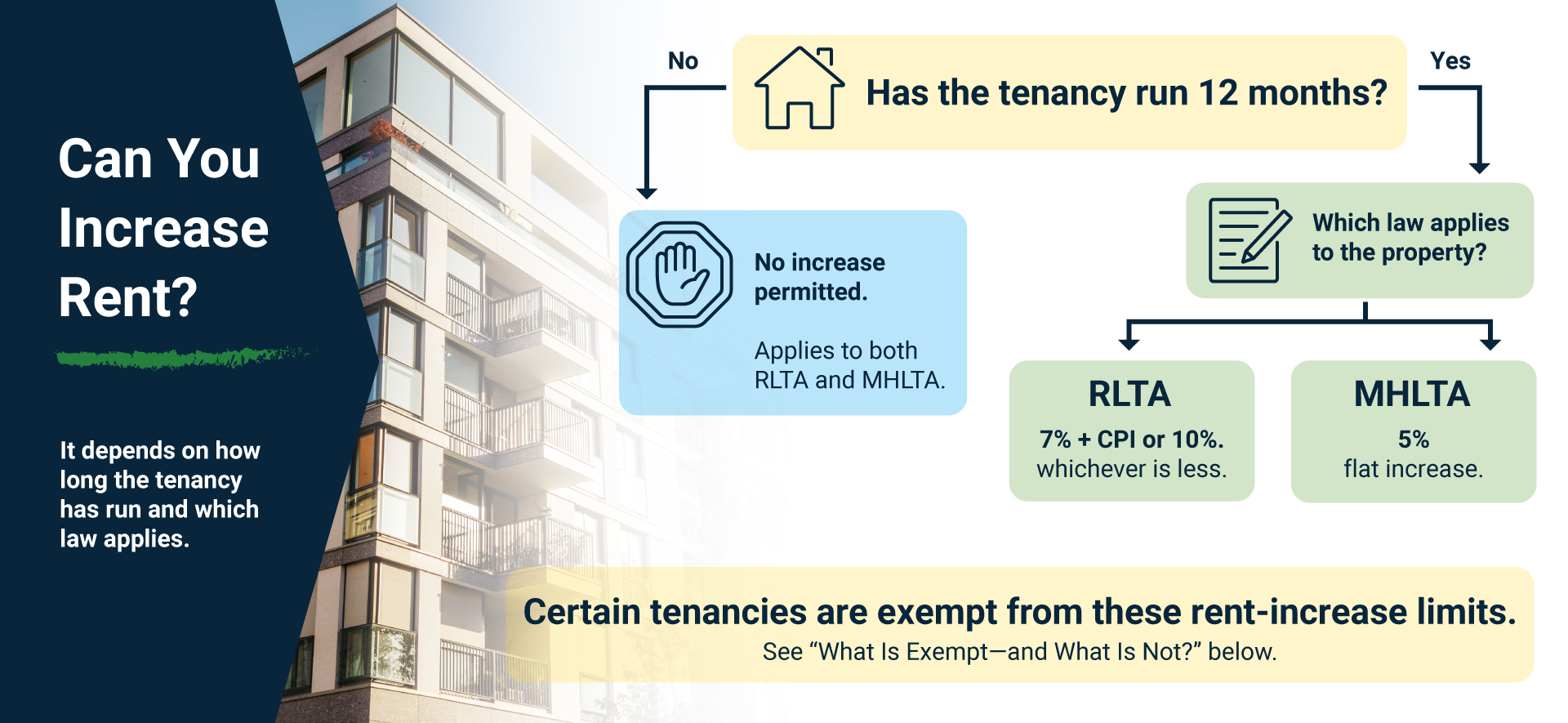
First, under both the RLTA and MHLTA, landlords generally may not increase rent during the first 12 months of a tenancy.
After that initial period:
- RLTA tenancies: rent increases during any 12-month period are capped at 7% plus the Consumer Price Index (CPI), or 10%, whichever is less.
- MHLTA tenancies: rent increases during any 12-month period are capped at 5%.
For RLTA properties, the cap does not restrict the amount of rent a landlord may establish after a tenant vacates and the tenancy ends. The RLTA rent-cap provisions are currently scheduled to expire July 1, 2040, unless extended by future legislation.
The Department of Commerce calculates the RLTA maximum each year using the June 12-month change in the Seattle-area CPI-U. The maximum allowable increase for 2026 is 9.683%. Commerce has announced that the maximum for 2027 will be 10%.
Under the RLTA, “rent” may include recurring charges beyond base rent, while excluding certain nonrecurring charges such as late-payment charges, damages, deposits, and legal fees. HB 1217 added a parallel definition under the MHLTA for recurring and periodic charges identified in the rental agreement.
What Is Exempt—and What Is Not?
Several exemptions permit rent increases above the otherwise applicable cap. Some apply under both statutes, while others are specific to the RLTA or MHLTA.
RLTA and MHLTA Tenancies
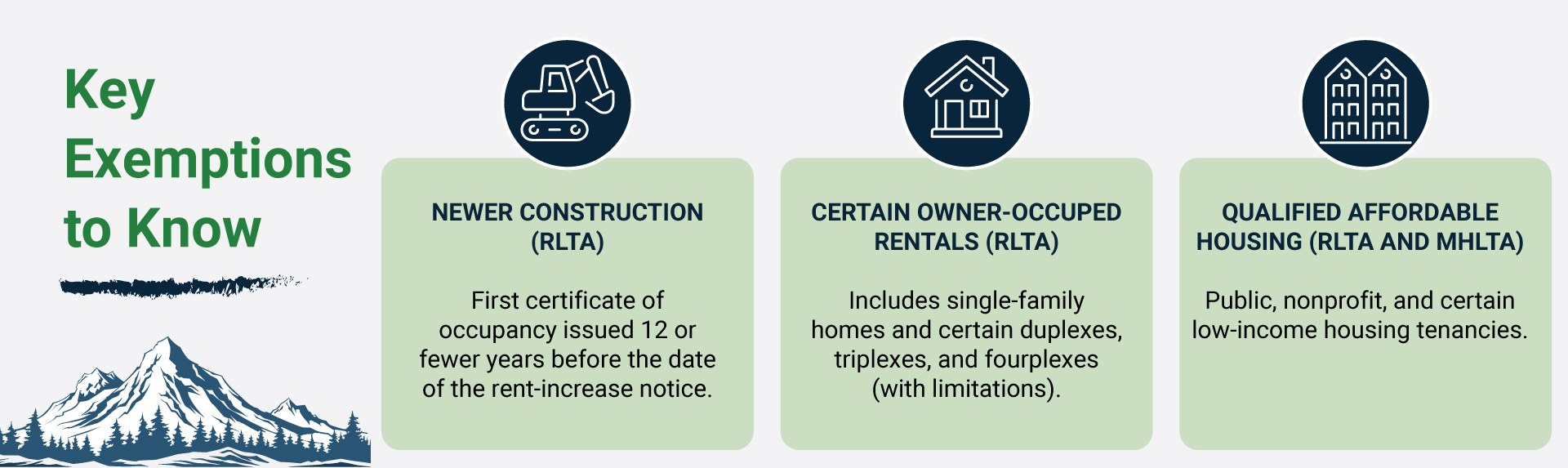
Certain public, nonprofit, and qualifying low-income housing tenancies are exempt where maximum rents are regulated by other laws or affordable-housing program requirements.
RLTA Tenancies Only
Additional RLTA exemptions include:
- Newer construction: a tenancy in a dwelling unit for which the first certificate of occupancy was issued 12 or fewer years before the date of the rent-increase notice.
- Certain low-income housing tax credit properties: where the property is subject to an enforceable regulatory agreement with the Washington State Housing Finance Commission.
- Certain owner-occupied rentals: including units where the tenant shares a kitchen or bathroom with an owner who resides on the property, certain owner-occupied single-family residences, and certain owner-occupied duplexes, triplexes, and fourplexes. These owner-occupied exemptions generally do not apply if the owner is a REIT, corporation, or an LLC with at least one corporate member.
Claiming an exemption is not self-executing. If a landlord increases rent above the statutory cap based on an exemption, the rent-increase notice must include facts supporting the exemption.
MHLTA Tenancies Only
The MHLTA includes additional exemptions for:
- the first 12 months after a qualified sale of a manufactured/mobile home community to an eligible organization whose mission includes preserving the affordability of the community, where the increase is necessary to cover acquisition costs and approved by a majority of homeowners; and
- a one-time rent increase at the first renewal after a rental agreement is transferred because a former tenant sells a manufactured or mobile home, provided the buyer received advance notice of that option before the transfer was finalized.
Rent Increase Notice Requirements
HB 1217 requires landlords to use a statutory Rent and Fee Increase Notice to Tenants form, or a form substantially similar to it. Notices must also comply with the applicable statutory notice period and service requirements.
For RLTA tenancies, landlords generally must provide at least 90 days’ prior written notice of a rent increase. A limited transition rule applies to certain fixed-term rental agreements entered into or renewed before May 7, 2025. Local ordinances may impose additional or longer notice requirements.
For MHLTA tenancies, landlords generally must provide written notice three months before the effective date of a rent increase.
Landlords claiming an exemption should be especially careful to include the supporting facts or documentation required by the statutory form.
Lease Parity, Fees, and Deposits
HB 1217 also created protections beyond the rent-increase cap.
Under both the RLTA and MHLTA, landlords may not report a tenant to a tenant-screening service for failing to pay the portion of rent that was unlawfully increased.
For RLTA tenancies, landlords must also maintain parity between lease types. A landlord generally may not impose materially more burdensome payment terms or conditions based solely on whether a tenancy is month-to-month or fixed-term. In addition, the difference in rent charged for different lease types for the same dwelling unit generally may not exceed 5%, and that difference cannot cause the rent to exceed the statutory cap.
For MHLTA tenancies entered into on or after May 7, 2025:
- move-in fees and security deposits combined generally may not exceed one month’s rent, or two months’ rent if the tenant has pets; and
- late fees are capped at 2% of monthly rent during the first consecutive month rent is past due, 3% during the second consecutive month, and 5% during the third and each subsequent consecutive month.
Remedies and Enforcement
If a landlord imposes an unauthorized rent increase, the tenant generally must first provide a written demand giving the landlord an opportunity to reduce the increase to a lawful amount.
A tenant or the Attorney General may then bring an action to enforce the applicable requirements. A prevailing tenant may recover excess rent, fees, or other costs paid, additional damages of up to three months of unlawful rent or fees, and reasonable attorney’s fees and costs.
The Attorney General may bring an enforcement action even if the tenant has not first provided an opportunity to cure and may seek civil penalties of up to $7,500 per violation.
The Attorney General has already exercised that authority. In August 2025, the office announced its first enforcement actions under the law, resulting in landlords withdrawing noncompliant rent-increase notices and refunding excess rent paid by tenants.
What Does This Mean for Landlords?
HB 1217 has now been in effect long enough that the compliance question has shifted from awareness to implementation.
The annual cap itself is only one part of the analysis. Landlords should also confirm that:
- rent-increase notices use the required statutory form;
- claimed exemptions are supported and properly disclosed;
- lease terms comply with parity requirements;
- applicable fee and deposit limits are followed; and
- local ordinances do not impose additional requirements.
Landlords should also monitor the Department of Commerce’s Landlord Resource Center, which publishes the annual RLTA rent cap and other compliance resources.
Bottom Line
Washington’s rent stabilization law significantly changed the rules governing rent increases, renewals, lease terms, and certain fees. With enforcement already underway, landlords should treat HB 1217 compliance as an ongoing operational issue rather than a one-time update.
Landlords and property managers should periodically review their lease forms, rent-increase notices, exemption documentation, and internal procedures to ensure continued compliance with both state law and any applicable local ordinances.
This article is intended for general informational purposes only and does not constitute legal advice. Landlords, property managers, developers, and property owners should consult legal counsel regarding the application of HB 1217 to their specific circumstances.
 Partner
As former in-house counsel to a real estate development company, Angela brings a practical and business-focused mindset to her work. She is recognized by clients for her efficiency, effectiveness, and creative solutions as well as ...
About this Blog
Stay current on legal news and issues, and learn more about Summit Law Group's practice groups.
Topics
Archives
Authors
Recent Posts
- Rent Stabilization is Live in Washington: Are Your Rent Increase Notices Compliant?
- Oregon Doubles Down on Middle Housing: What HB 2138 Means for Developers
- Washington's Amended Fair Chance Act Is Live: Are Your Organization's Processes Compliant?
- Moving Your LLC Out of Washington: What Property Owners Should Know
- Negotiating Leases as a Commercial Tenant
- Construction Defect Reform Comes to Oregon: What Developers and HOAs Need to Know
- Washington Limits Parking Requirements: What SB 5184 Means for Developers
- New Development Opportunities Near Transit: What Washington's HB 1491 Means for Developers
- Washington Expands Condo Liability Reform: What Developers Need to Know
- Preparing Seattle for the World Stage: Reflections on the Road to the 2026 FIFA World Cup