
Oregon has joined neighboring states in revisiting condominium construction-defect laws. Enacted in 2025, HB 3746 shortens the period for certain construction-defect claims while establishing new inspection and procedural requirements for homeowners associations and condominium associations.
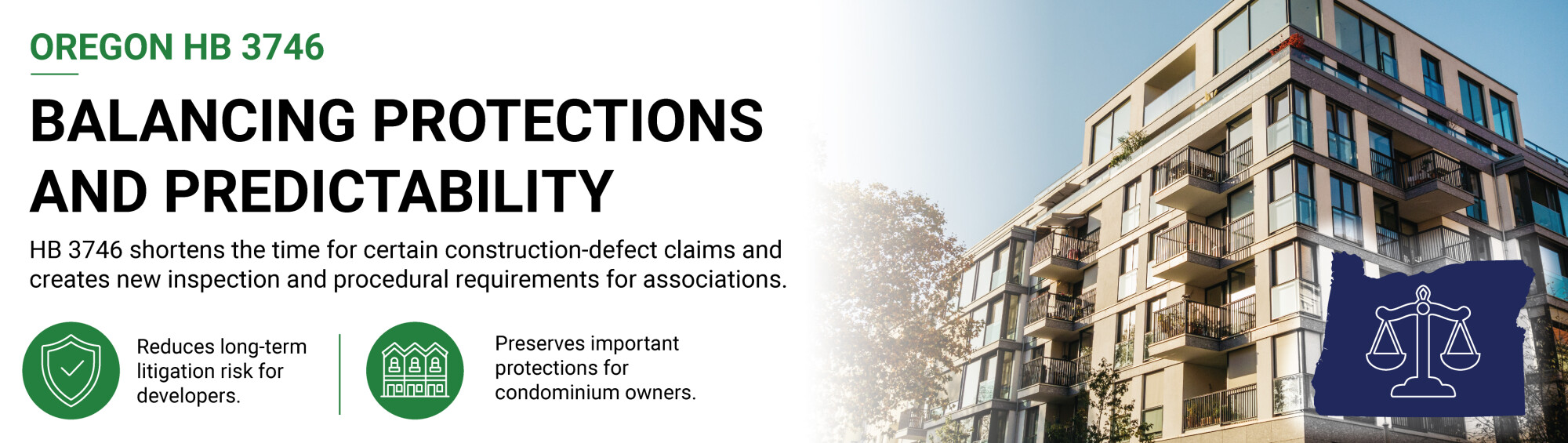
The legislation seeks to reduce long-term construction-defect litigation risk for developers while preserving protections for condominium owners. For developers and associations alike, understanding these new requirements will be essential when planning projects and responding to potential construction defects.
Why the Reform?
Supporters of HB 3746 argued that prolonged litigation exposure and rising insurance costs have contributed to declining condominium development in Oregon. The Legislature responded by shortening the time for certain construction-defect claims while requiring earlier inspections intended to identify problems before the claim period expires.
The legislation also establishes additional procedures before homeowners associations and condominium associations may pursue construction-defect litigation, giving owners greater notice and involvement in the process.
From Ten Years to Seven: The New Repose Period
For condominium declarations filed after January 1, 2026, HB 3746 generally gives homeowners associations and condominium associations seven years—instead of ten—to bring certain construction-defect claims.
The seven-year period runs from substantial completion or abandonment of the construction, alteration, or repair of the structure. After the seven-year period expires, no action may be brought. However, if a defect is discovered between the sixth or seventh year after substantial completion, the association has an additional year to bring a claim.
Condominiums in which each owner is responsible for both the interior and exterior of the owner's unit are exempt from the seven-year limitation and from the inspection requirements discussed below.

Moisture Inspections Before the End of Year Two and Year Six
The shorter claim period comes with a corresponding obligation—mandatory independent moisture-intrusion inspections.
HB 3746 requires two independent moisture-intrusion inspections: one before the end of the second year following substantial completion, funded through the association's reserves, and another before the end of the sixth year.
Supporters described these inspections as a way to identify building-envelope and moisture-intrusion problems while associations still have time to investigate and pursue claims.
At the turnover meeting, the declarant must provide the association with the inspection results, along with the inspector's name.

Procedural Requirements for HOA Legal Claims
HB 3746 also creates additional procedural requirements for homeowners associations and condominium associations pursuing construction-defect claims. Associations now face a staged process that may add three months or more before a complaint can be filed.
What Stays the Same
Before suing on owners' behalf, the association must continue to provide each affected owner with written notice at least 10 days before initiating litigation.
The notice must continue to include:
- the nature of the lawsuit;
- the damages the association seeks to recover;
- the terms under which the association is acting on behalf of owners, including how any recovery will be distributed; and
- the owner's right to opt out by submitting a written request within 10 days after the notice is mailed.
What HB 3746 Adds
HB 3746 establishes several additional requirements for construction-defect claims.
- The association's board must formally approve the litigation at a properly noticed meeting pursuant to ORS 94.644.
- The board may not vote until at least 90 days after the first notice is sent to owners. Before the vote, the association must also send a second notice and then a third notice, with at least 15 days between the final notice and the board meeting. In practice, this process may delay filing by three months or more.
- The notice must state that the association believes a construction-defect exists, describe the defect in detail, identify the parties believed to be responsible, and list each board member along with contact information.
- The notice must also advise owners that pending litigation may make selling a unit more difficult and encourage owners to provide input before the board votes.
- A copy of the notice must be sent by certified mail to each person identified as potentially responsible for the defect.

What Does This Mean for Developers and Associations?
HB 3746 reflects Oregon's effort to balance two competing objectives: preserving meaningful protections for condominium owners while reducing the long-term liability exposure that developers argue has discouraged new condominium construction.
For developers, the legislation may reduce litigation exposure for certain future condominium projects. For homeowners associations and condominium associations, however, the shorter claim period and additional procedural requirements make early inspections, careful recordkeeping, and timely investigation of potential defects increasingly important.
Developers, declarants, and associations should understand which provisions apply to a particular project and carefully track the applicable deadlines.
Bottom Line
Whether HB 3746 ultimately encourages additional condominium development remains to be seen. For now, developers, builders, homeowners associations, and condominium associations should familiarize themselves with the new requirements and consult legal counsel early when evaluating potential construction-defect issues.
This article is intended for general informational purposes only and does not constitute legal advice.
 Partner
As former in-house counsel to a real estate development company, Angela brings a practical and business-focused mindset to her work. She is recognized by clients for her efficiency, effectiveness, and creative solutions as well as ...
About this Blog
Stay current on legal news and issues, and learn more about Summit Law Group's practice groups.
Topics
Archives
Authors
Recent Posts
- Rent Stabilization is Live in Washington: Are Your Rent Increase Notices Compliant?
- Oregon Doubles Down on Middle Housing: What HB 2138 Means for Developers
- Washington's Amended Fair Chance Act Is Live: Are Your Organization's Processes Compliant?
- Moving Your LLC Out of Washington: What Property Owners Should Know
- Negotiating Leases as a Commercial Tenant
- Construction Defect Reform Comes to Oregon: What Developers and HOAs Need to Know
- Washington Limits Parking Requirements: What SB 5184 Means for Developers
- New Development Opportunities Near Transit: What Washington's HB 1491 Means for Developers
- Washington Expands Condo Liability Reform: What Developers Need to Know
- Preparing Seattle for the World Stage: Reflections on the Road to the 2026 FIFA World Cup